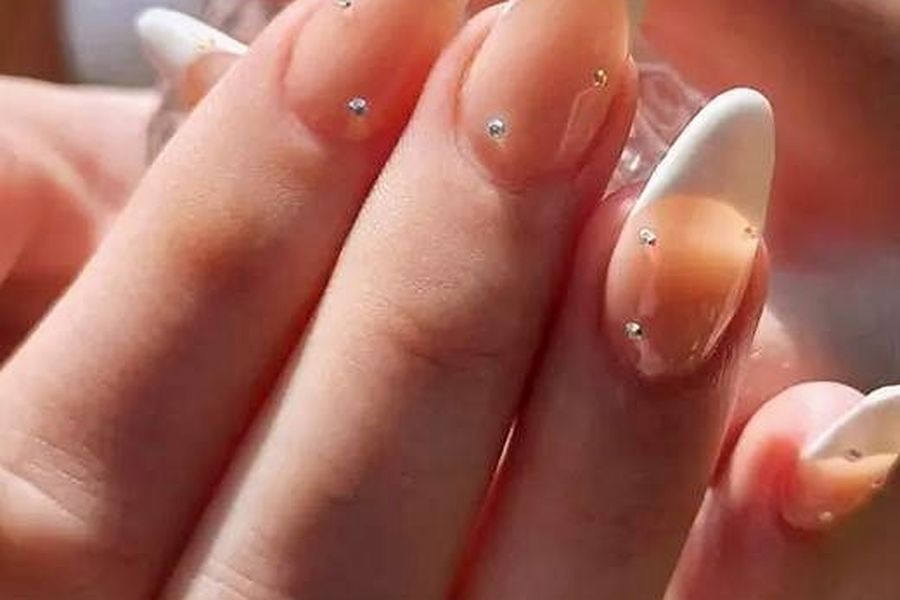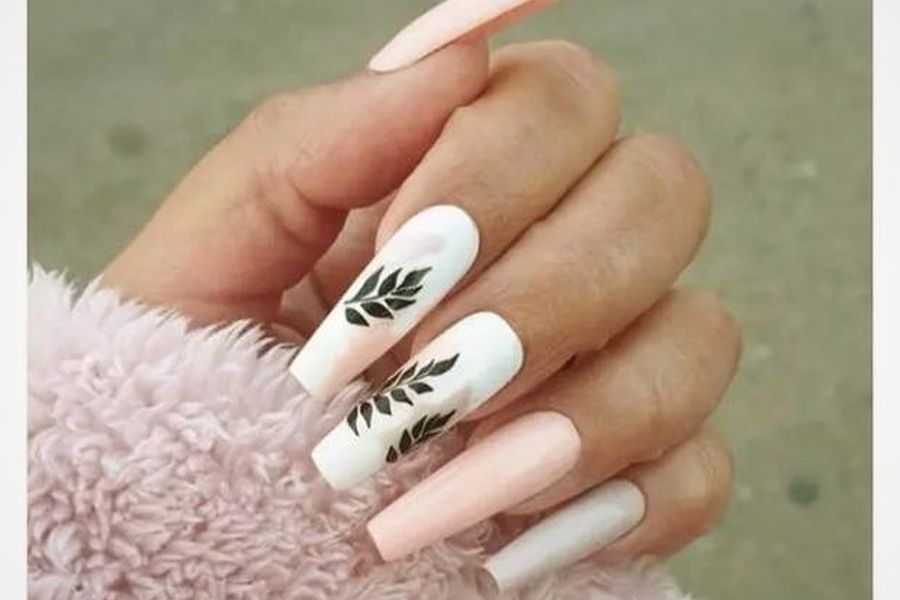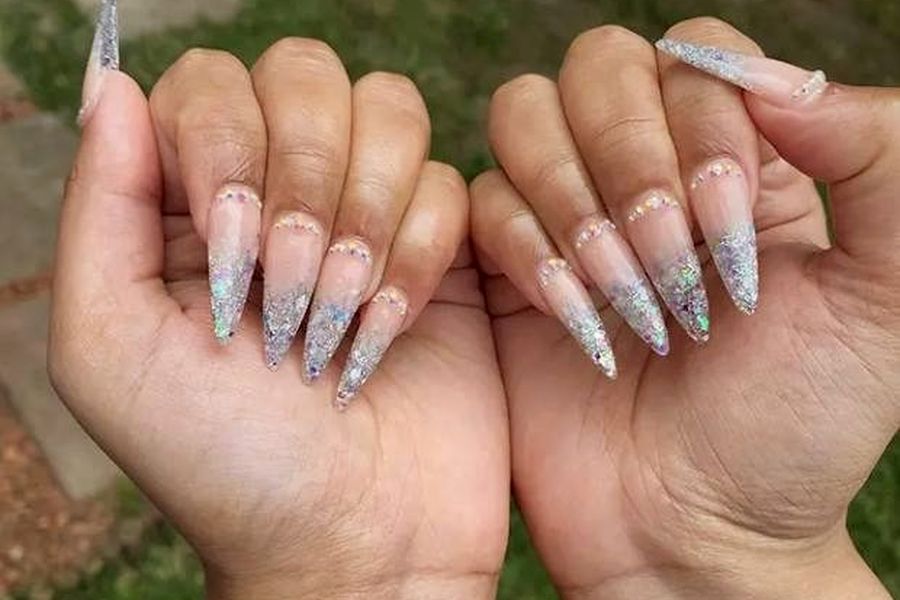

The gap between the set you imagined and the set you got is almost always a briefing problem, not a skill problem. Nail art is a translation exercise: what is in your head has to travel through words to somebody else's hands. Here is how to make that translation reliable.
Bring a picture, not a description
This is the single most useful thing you can do. "Something pink and pretty with a bit of sparkle" describes several thousand different sets. A photograph describes one.
Bring two or three images rather than one, because what you like is often clearer from the overlap than from any single picture. And be ready to say what you like about each — it is frequently not what the technician would have guessed. You may have saved a photo for the colour while assuming the shape came with it.
Screenshots on your phone are perfect. There is no need to print anything or make a mood board.
Shape and length come first
People discuss colour first and shape as an afterthought, which is the wrong way round. Shape and length affect how a set wears, how it feels, what it costs and whether you can do your job.
Decide, roughly, between short and practical, medium, or long. Then shape: square, squoval, almond, coffin or stiletto. If you do not know the names, point at a picture or at your own hand and say "about here".
Be realistic. A long stiletto set is beautiful and it will change how you type, fasten a bra, open a tin and pick up a coin. Nobody minds if you want them anyway — but choose knowing, rather than discovering on day two.
Be honest about your day
This is the part clients skip and technicians most need. What do your hands actually do?
- Typing all day means length has a practical ceiling
- Gardening, cleaning or anything with chemicals means gloves and probably a harder product
- Working with children or animals means shorter and rounder, for their sake as much as yours
- Playing an instrument usually rules out length entirely on one hand
- Frequent hand-washing changes what will last
A technician who knows this will steer you towards something that survives your life. One who does not will give you exactly what you asked for, and you will be back in ten days.
What freehand can and cannot do
Thalia works freehand — a thin brush, polishes and gel overlays, painted directly rather than assembled from stickers or stamps. That means the work is genuinely bespoke, and it also means it has its own character.
Freehand can do: detailed line work, florals, lettering, colour blends, tiny repeated motifs, and interpretations of a picture in her own hand. It is at its best when it is given room — one or two feature nails carrying detail, with the rest supporting them.
What freehand is not is a photocopier. A hand-painted version of a machine-printed design will differ, and that difference is the point of paying for artistry rather than a decal. If you need something reproduced exactly, say so, and you will get an honest answer about whether it is achievable.
Very fine detail also needs surface area. A design that looks crisp on a long coffin nail may not fit on a short square one, and squeezing it in rarely improves it. If you want the detail, you may need the length.
Talking about cost
Nail art per finger and unique sets are quoted on request rather than fixed on the price list, and there is a straightforward reason: they are priced by time and complexity, and neither can be known before someone has seen the design.
The way to handle this is to ask up front. Show the picture, say how many nails you want detailed, and ask what it will come to. You will get a figure before anything starts. Nobody wants a surprise at the end, least of all us.
If the answer is more than you had in mind, say so plainly. There is almost always a version — fewer feature nails, simpler line work, a single accent — that gets most of the effect for less. Asking for that is completely normal.
The base underneath
Art sits on something, and that something has a price of its own. Acrylic tips are R320, French tips R270, an acrylic and gel combo R370. Overlays run from R240 for gel to R330 for acrylic with gel. Nail art is quoted on top.
Mention if you want the art to survive as long as possible — that may point towards a harder base than you would otherwise have chosen.
Speak up during, not after
If the colour is going on differently from what you pictured, say so at nail two, not at nail ten. Colour reads differently in a bottle, on a swatch and on a hand, and this is completely normal and completely fixable early.
Technicians would far rather adjust at the start than have you leave politely disappointed. "That is lighter than I imagined — can we go a shade deeper" is a helpful sentence, not a rude one.
Booking with Thalia
For a detailed set, book ahead and mention that you want nail art when you call, so the time is allowed for. Detailed work is not something to squeeze into a standard slot.
Call the nail bar on 073 590 3317, and bring your pictures.
Bringing a design that is somebody else's work
Most reference pictures started life as a real technician's set, photographed and reposted until nobody remembers whose it was. That is fine as a reference — it is how the whole industry communicates — but it is worth knowing the difference between "make me this exact set" and "this is the direction I like".
The second gets you a better result almost every time. A design adapted to your nail shape, your length and your colouring will suit you more than a faithful copy of a set made for somebody else's hands.
Colour, and how it reads on you
Colour behaves differently against different skin tones, and a shade that looked wonderful in a photograph can fall flat in person. If you are unsure, ask to see the polish against your own hand before committing — thirty seconds that saves a set you do not love.
Two rules of thumb worth having. Cooler, bluer shades tend to sharpen; warmer, golden-based shades tend to soften. And a nude is not one colour — the right nude is the one that flatters your hand, not the one that matches somebody else's.
After the set
Hand-painted detail benefits from the same care as any other set: cuticle oil daily, gloves for washing up, and no picking. Detailed work is generally sealed under a gel top coat, which protects it, but the edges are still where wear starts.
If a feature nail chips, come in rather than living with it — a single nail repair is R30, and repainting one nail is far quicker than redoing a set.